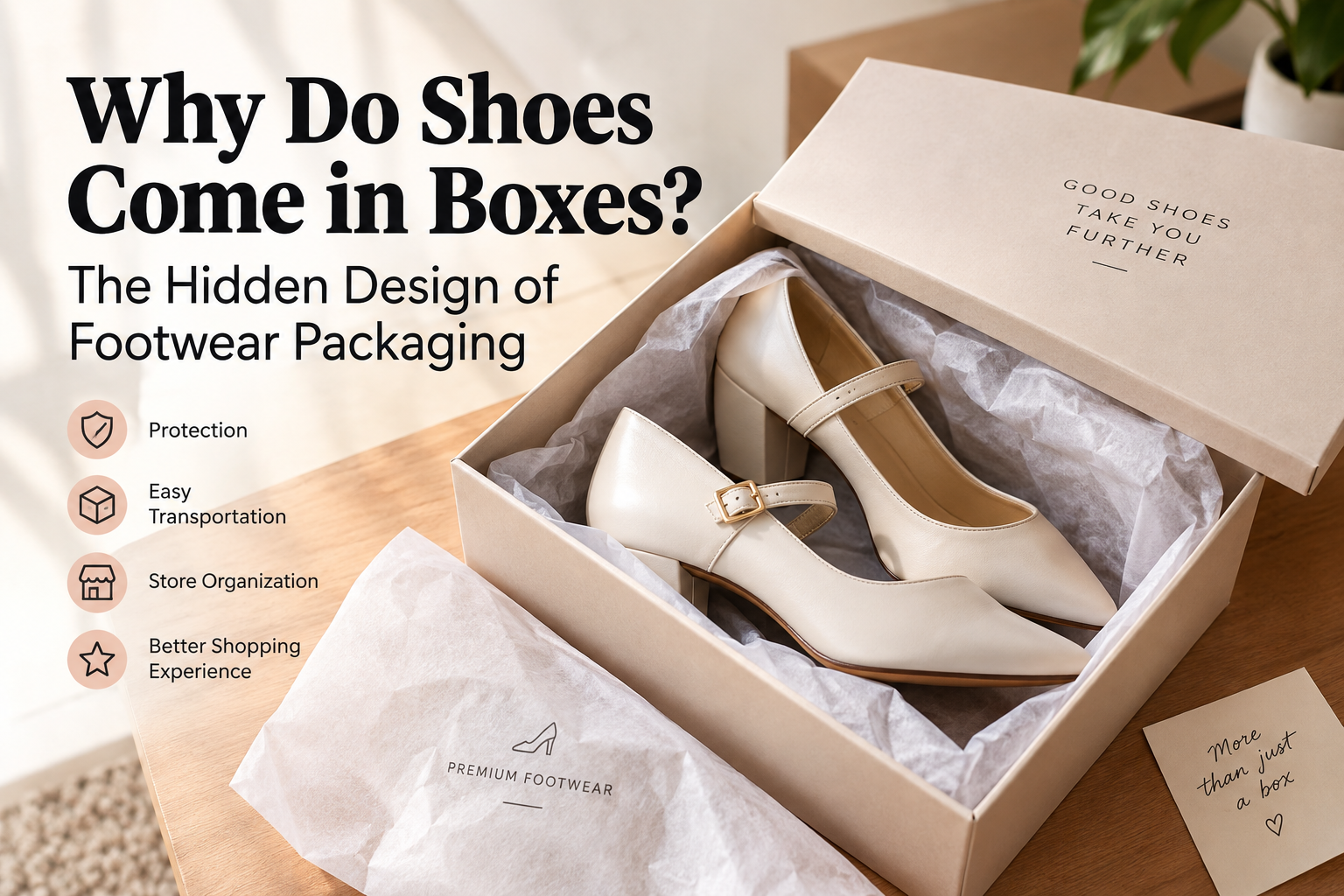
When you buy a new pair of shoes, the box is usually the first thing you see.
Before you even touch the shoes, you may notice the size label, the printed logo, the shape of the box, the tissue paper inside, or the way the shoes are arranged. Once the shoes are taken out, the box often gets pushed into a closet, recycled, or forgotten.
But have you ever wondered why shoes come in boxes in the first place?
A shoe box is much more than a container. It protects the footwear, makes transportation easier, helps stores organize products, and creates part of the experience of buying something new. Even small details in packaging can influence how a product feels before it is ever worn.
Let's take a closer look at the surprisingly thoughtful design behind the humble shoe box.
1. A Shoe Box Has One Very Important Job: Protection
The most obvious purpose of a shoe box is to protect the shoes.
Shoes can be exposed to pressure, dust, moisture, friction, and movement while they are being transported or stored. Without some form of packaging, delicate materials and decorative details could easily become damaged before reaching the customer.
Imagine a pair of structured shoes being packed directly into a large shipping carton with other products. During transportation, the shoes could rub against one another or become compressed under heavier items.
A properly designed box creates a dedicated space for the pair.
It helps reduce unnecessary movement and gives the shoes a layer of protection between the product and the outside world.
This is particularly useful for footwear with details that need to maintain their original shape, such as structured uppers, decorative elements, pointed toes, or carefully finished surfaces.
The box does not make the shoes indestructible, of course. But it helps them arrive looking much closer to the way they were intended to look.
2. Why Are Shoe Boxes Usually Rectangular?
There is a simple reason most shoe boxes have a familiar rectangular shape: it makes them practical to store and transport.
Shoes themselves are not perfectly rectangular. They have curves, angles, heels, and different proportions. Yet placing them inside a rectangular container creates a standardized shape that is much easier to handle.
Rectangular boxes can be stacked.
They can fit together more efficiently on shelves and inside larger shipping cartons. They can also be labeled, organized, and moved without requiring complicated packaging for every individual shoe shape.
This is an important principle of packaging design:
The package does not necessarily have to copy the exact shape of the product. It needs to protect the product while remaining practical for storage and movement.
That is why a pair of beautifully curved shoes can spend most of its journey inside a surprisingly ordinary-looking box.
3. Tissue Paper Is Not Just for Presentation
Open a shoe box and you may find the shoes wrapped in thin tissue paper.
At first glance, tissue paper can seem decorative. It makes the unboxing experience feel more special and gives the product a neat, carefully prepared appearance.
But it can also serve practical purposes.
The paper can create a barrier between shoes and reduce direct contact between surfaces. This can be useful when footwear has finishes or materials that could rub against one another during transportation.
It also helps create a sense of separation between the individual shoes and other packaging materials.
In some cases, paper or other inserts may also be used to help footwear maintain its shape while inside the box.
So that small sheet of paper that people sometimes throw away immediately can actually be part of the packaging system rather than simply decoration.
4. Shoe Boxes Help Stores Manage Thousands of Products
Imagine a shoe store without boxes.
Pairs of shoes would still need to be stored somewhere. Different sizes, colors, styles, and variations would have to be organized and identified.
A standardized box makes this process much easier.
Labels can provide information such as:
-
Shoe size
-
Color
-
Style or product number
-
Barcode information
-
Brand information
-
Other inventory details
Instead of relying on memory or visually identifying every pair, a store can organize footwear through packaging and labeling.
This becomes especially important when a single design is available in many sizes.
A customer might see one display pair on the sales floor, while the actual size needed is stored somewhere behind the scenes. The box helps employees identify and retrieve the correct product efficiently.
In this way, the shoe box is not only part of the customer experience.
It is also part of the retail system operating behind the scenes.
5. Packaging Turns a Pair of Shoes Into a Complete Product
There is an interesting difference between seeing shoes individually and receiving them as a packaged pair.
A shoe sitting on a shelf is a physical object.
A pair of shoes inside a carefully arranged box feels more like a finished product.
Packaging gives the product a defined beginning and ending. The box, wrapping, labels, inserts, and shoes work together as one presentation.
This is one reason packaging can be important to fashion brands.
A customer is not only purchasing the physical function of footwear. They are also experiencing the process of receiving it.
Opening a box creates a small moment of anticipation:
You see the package.
You open it.
You remove the wrapping.
You discover the shoes.
You finally try them on.
That sequence can make the purchase feel more memorable than simply picking an item up from a shelf.
6. The Shoe Box Is Also a Brand's First Impression
A shoe box can communicate something about the company before the customer has even worn the product.
Consider how different packaging choices can create different impressions.
A simple box with minimal printing can feel understated.
A highly designed box can feel expressive.
A carefully coordinated package can reinforce a brand's visual identity.
Even typography, spacing, labels, and small printed details can contribute to the overall impression.
This is why packaging design is often treated as part of branding rather than merely logistics.
The product may be the star, but the box is part of the stage.
And because customers physically interact with the packaging, it can become part of their memory of the purchase.
7. Why the Box Often Feels Bigger Than Necessary
One common question about shoe packaging is why there seems to be so much empty space.
There are several practical reasons.
Shoes are not perfectly flat objects. Their shapes can vary significantly depending on the style. A box needs enough room to accommodate the pair without compressing important areas.
Extra space can also allow for protective paper, inserts, labels, and other packaging components.
At the same time, too much empty space is not ideal.
A very large box requires more material and can take up more storage and shipping space. The shoes may also move around more inside the package.
This creates a balancing act for packaging designers:
The box needs to be large enough to protect the product, but not unnecessarily large.
Good packaging is therefore a compromise between protection, efficiency, presentation, and material use.
8. Packaging Design Matters Even More in Online Shopping
In a physical store, customers can see the shoes before purchasing them.
Online shopping is different.
The customer may spend days waiting before physically interacting with the product.
That means the package becomes an important part of the transition from digital shopping to physical ownership.
A customer clicks "buy" on a screen.
Later, a box arrives at the door.
The moment the box is opened, the online purchase becomes a physical experience.
This is one reason ecommerce packaging has become an important part of product presentation.
The package needs to survive shipping, protect the product, provide useful information, and still create a positive arrival experience.
In other words, the shoe box has to work for both logistics and emotion.
9. Why Some People Keep Their Shoe Boxes
Not everyone keeps shoe boxes.
Some people immediately recycle them. Others keep them for months or even years.
There are practical reasons for keeping them.
A box can provide a convenient place to store a pair when the shoes are not being worn. It can help keep dust away and make it easier to organize less frequently used footwear.
Boxes can also be useful when shoes need to be transported, moved, or stored for a longer period.
But there is another reason people sometimes keep them:
The box can feel like part of the product.
Especially when the packaging is beautifully designed, throwing it away can feel like throwing away part of the experience.
That says something interesting about modern retail.
We do not always separate the product from everything surrounding it. Sometimes the surrounding details become part of what we remember.
10. Packaging Has to Balance Beauty and Practicality
A beautiful package is not automatically a good package.
If it looks impressive but fails to protect the shoes, it has not done its main job.
Likewise, extremely protective packaging may be functional but unnecessarily complicated.
Good packaging usually has to balance several considerations:
Protection — Can it keep the product safe?
Organization — Can the product be identified and stored easily?
Efficiency — Can the package be transported without unnecessary space or material?
Presentation — Does opening it feel appropriate for the product?
Brand identity — Does it communicate the character of the company?
Material use — Can the design avoid unnecessary packaging?
These goals can sometimes conflict with one another.
A larger amount of protective material may offer additional protection but require more resources. A minimalist package may reduce material use but need a carefully engineered structure to achieve the same level of protection.
Packaging design is therefore not as simple as choosing a pretty box.
11. What Happens to the Box After the Shoes Come Out?
The life of a shoe box does not necessarily end when the shoes are removed.
Some boxes become storage containers.
Others are reused for moving, organizing small items, or storing accessories.
And many eventually enter the recycling stream, depending on local recycling rules and the materials used.
This raises an interesting idea: packaging can have a second life.
A box that is designed with a practical size and straightforward materials may be easier to reuse or recycle than packaging that combines many unnecessary components.
For consumers, one simple habit can make a difference:
Before throwing a box away, consider whether it can be reused.
Sometimes the most sustainable packaging choice is simply using the same box again.
12. The Future of Shoe Packaging
As shopping habits change, footwear packaging will continue to evolve.
Online retail puts different demands on packaging than traditional store-based shopping. Customers expect products to arrive safely, while businesses need packaging that can move efficiently through increasingly complex delivery systems.
At the same time, there is growing attention on reducing unnecessary packaging and making materials easier to reuse or recycle.
The challenge is finding the right balance.
A shoe still needs protection.
A package still needs to survive transportation.
A customer still expects the product to arrive in good condition.
The future of footwear packaging will likely be less about simply using more packaging and more about designing packaging more intelligently.
Smarter dimensions.
More efficient structures.
Fewer unnecessary components.
Materials selected with their entire use cycle in mind.
The best package may ultimately be the one that does its job so well that you barely notice how much thought went into it.
Final Thoughts
The next time you open a shoe box, take a second look before throwing it away.
That simple rectangular container has already done quite a lot.
It helped organize the product, protected it during transportation, communicated information, supported retail operations, and created the moment when an online or in-store purchase finally became something physical.
Shoes may be the reason the box exists, but the box has its own story.
And sometimes, the most ordinary objects around fashion are the ones with the most interesting design decisions hidden inside them.