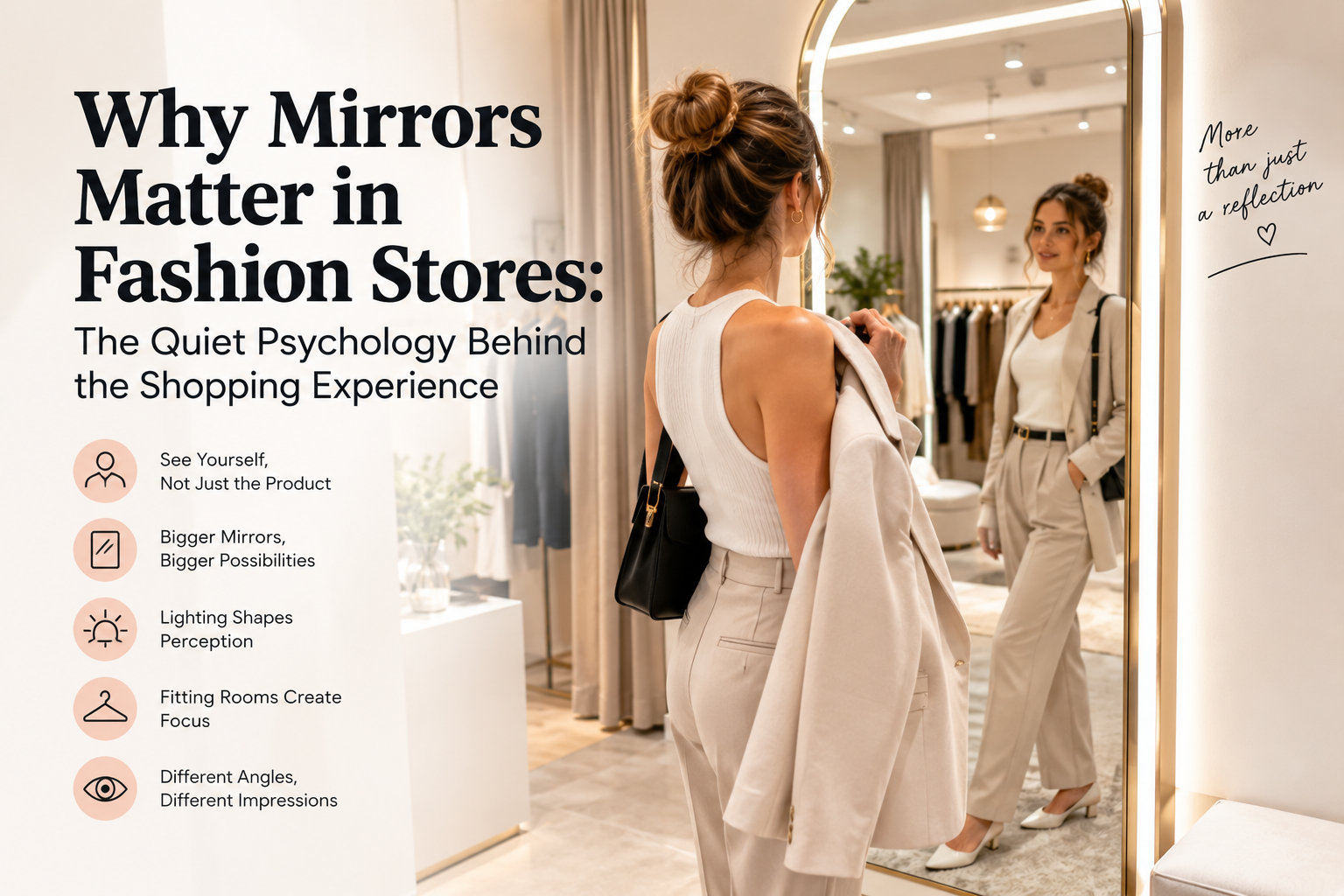
Walk into almost any fashion store and you will probably find a mirror.
Some are small and practical. Others cover an entire wall. Some are positioned directly beside fitting rooms, while others are placed in unexpected corners of the store.
We rarely question their presence.
After all, if you are trying on clothes or shoes, you need to see how they look.
But mirrors do more than simply show us our reflection.
Their size, position, lighting, angle, and surroundings can influence how we experience what we are looking at. A mirror can change the way a product is perceived, alter the atmosphere of a space, and become an important part of the shopping experience without attracting much attention itself.
So why are mirrors such an important part of fashion retail?
1. A Mirror Turns a Product Into a Personal Experience
Before trying something on, a fashion item is simply an object.
It is sitting on a shelf or hanging on a rack.
Once you stand in front of a mirror wearing it, the relationship changes.
You are no longer looking at the product alone.
You are looking at yourself with the product.
That difference is significant.
Instead of asking only, “What does this item look like?” you naturally begin asking questions such as:
“How does this look on me?”
“Does it feel like my style?”
“Would I wear this outside the store?”
The mirror creates a transition between observing a product and imagining yourself owning it.
That is one reason mirrors are so closely connected with fashion retail.
2. The Size of a Mirror Changes What You Can See
A small mirror shows only part of an outfit.
A larger mirror can reveal proportions, movement, and how different pieces work together.
This becomes especially useful when evaluating something that extends beyond the upper body.
When you can see more of yourself at once, you can consider the overall appearance rather than focusing on one isolated detail.
For footwear, a full-length mirror can be particularly useful.
Shoes rarely exist visually on their own when someone is actually wearing them. They interact with trousers, skirts, dresses, coats, and other parts of an outfit.
Seeing the complete silhouette can provide a very different impression from looking down at your feet.
The mirror therefore changes the scale of the evaluation.
Instead of examining one product, you begin seeing the relationship between the product and the person wearing it.
3. Lighting Is Part of the Mirror Experience
A mirror does not exist independently of the environment around it.
Lighting matters.
The same outfit can look different under bright overhead lights, soft lighting, natural daylight, or warmer indoor illumination.
This is not necessarily because the product itself has changed.
The surrounding visual conditions have changed.
Retail designers therefore have to think about more than simply where to place mirrors. They also have to consider what customers will see when they stand in front of them.
A mirror surrounded by harsh lighting creates a different experience from one placed in a softer, carefully designed environment.
This is one reason a fitting-room area can feel noticeably different from the rest of a store.
The lighting, walls, mirror, floor, and space around the customer all work together.
4. Why Fitting-Room Mirrors Feel Different
A fitting room provides something that an open store usually cannot: privacy.
That changes the experience.
In the middle of a store, a customer may be conscious of other people walking around.
Inside a fitting room, attention can become more focused.
There is time to stand still.
Turn around.
Look from different angles.
Adjust the item.
Step closer to the mirror.
Step back.
The mirror becomes part of a much more concentrated evaluation process.
This is particularly important for products where small details matter.
Instead of making a quick judgment while walking through the store, the customer has an opportunity to spend more time with the product.
The mirror becomes less like a display and more like a personal viewing space.
5. Why We Look From Different Angles
When people look at themselves in a mirror while trying something on, they rarely remain completely still.
They turn sideways.
They look down.
They take a few steps.
They adjust their posture.
They may even walk toward another mirror.
There is a reason for this.
A fashion item is not a flat image.
It has volume and movement.
Something that looks appealing from the front may create a completely different impression from the side or back.
This is especially relevant to footwear.
The appearance of a shoe can change depending on the viewing angle. The relationship between the toe, heel, sole, and leg can be perceived differently when viewed from different positions.
A mirror allows customers to explore these changes in real time.
6. Mirrors Help People Imagine Real-Life Use
A fashion purchase involves a small act of imagination.
You are not only deciding whether you like something in the store.
You are imagining what happens after the purchase.
Where will you wear it?
What will you wear with it?
How will it look when you are walking?
Will it still feel like your style outside the store?
Mirrors can support this process because they provide an immediate visual reference.
Instead of imagining an unknown person wearing the item, you see yourself.
That can make the future use of the product feel more concrete.
The store becomes a temporary preview of your own wardrobe.
7. Why Some Stores Use Very Large Mirrors
Large mirrors can serve practical and visual purposes at the same time.
From a practical perspective, they allow customers to see more of an outfit.
From a spatial perspective, mirrors can also make an interior appear more open because they reflect light and surrounding space.
This does not mean every store needs enormous mirrors.
The appropriate size depends on the environment, the type of products being sold, and the experience the retailer wants to create.
But there is an interesting principle behind large mirrors:
They do not simply show more of the customer.
They also show more of the relationship between the customer and the surrounding environment.
The reflection becomes part of the store's visual composition.
8. Mirrors Can Make a Store Feel More Personal
A product display speaks to a group of shoppers.
A mirror speaks to one person at a time.
When you stand in front of a mirror, the experience becomes highly individual.
The store may contain hundreds of products, but for a moment your attention narrows to one reflection.
This is one of the quiet powers of mirrors.
They create a personal moment inside a commercial environment.
Instead of simply looking at merchandise, you become part of the visual experience.
9. Why People Sometimes Take Photos in Store Mirrors
The relationship between mirrors and fashion has changed with smartphones.
A mirror can now become a temporary photo studio.
Someone may take a picture to compare two outfits, remember a particular look, ask a friend for an opinion, or simply see how an item looks in a photograph.
This creates another layer of evaluation.
The customer is no longer looking only at the mirror.
They are also looking at an image of the mirror.
That can be useful because photographs provide a different perspective from immediate visual perception.
Something may look one way in person and another way in a photograph.
For shoppers, this can become an additional step in deciding whether a product feels right.
10. The Mirror Is Part of the Store's Design Language
Just like shelves, lighting, flooring, signs, and displays, mirrors contribute to the identity of a retail space.
A simple frame can communicate a different atmosphere from an ornate one.
A frameless mirror may feel contemporary.
A vintage-style mirror may create a more traditional atmosphere.
A large architectural mirror can become a design feature rather than merely a functional object.
This means the mirror has two jobs.
It serves the customer.
And it contributes to the store.
The best retail environments often make these two purposes feel completely natural.
You do not necessarily think, “This mirror has been carefully positioned as part of the store design.”
You simply experience the space as a whole.
11. The Mirror Can Change the Way We Notice Details
When looking directly at a product on a shelf, our attention is usually focused on the product itself.
Once we see it on a person, different details become visible.
Proportion becomes easier to understand.
Scale becomes more obvious.
Movement becomes relevant.
The relationship between different pieces becomes clearer.
For footwear, the effect can be especially noticeable.
A shoe that looks dramatic on a display shelf may appear completely different when seen as part of a complete outfit.
Another pair that seemed simple in isolation may suddenly look balanced and elegant when worn.
The mirror provides context.
And context can change perception.
12. Why a Good Mirror Experience Does Not Need to Be Dramatic
A successful mirror does not have to be unusual.
It does not need a complicated frame.
It does not need special technology.
It simply needs to help customers see clearly and comfortably.
The most useful mirror may be the one people barely notice.
It is positioned at a sensible height.
The lighting is appropriate.
There is enough space to step back.
The surrounding area is not distracting.
The reflection is clear.
Everything works together without demanding attention.
This is an important lesson in design:
Good design often disappears into the experience it creates.
13. Online Shopping Has Changed the Role of Mirrors
Online shoppers do not have access to a physical fitting-room mirror.
Instead, they rely on product photography, model images, videos, reviews, measurements, and sometimes virtual try-on technology.
These tools attempt to solve the same basic problem:
How will this product look when it becomes part of my life?
The physical mirror provides an immediate answer because the customer is already wearing the item.
Online shopping has to create that sense of context through other forms of visual information.
This is one reason images showing products from multiple angles can be so useful.
A single product photograph can show what an item looks like.
A broader set of images can help communicate how it exists in relation to a person.
The goal is similar, even though the method is different.
14. Mirrors Are More Than Objects
A mirror appears simple.
It reflects an image.
But in a fashion environment, that reflection becomes part of a larger process.
It helps people compare.
Imagine.
Evaluate.
Adjust.
Experiment.
And sometimes change their minds.
That makes the mirror an unusual object in retail.
It does not sell the product directly.
It does not explain the materials.
It does not describe the design.
Instead, it gives the customer a chance to place the product into a personal context.
And that may be its most important function.
Final Thoughts
The next time you walk into a fashion store, pay attention to the mirrors.
Notice where they are placed.
Look at the lighting around them.
Notice how much of your outfit you can see.
Think about how different the product feels when you see it on a shelf compared with seeing it on yourself.
A mirror may seem like one of the most ordinary objects in a store.
But it quietly connects the product, the customer, and the space around them.
Fashion is ultimately something people experience on themselves, not just something they observe.
And the humble mirror is one of the simplest tools that makes that experience possible.